Below zero
The modelled contribution does not recover the investment. Reduce scope, improve the mechanism, or choose no action.
SEO ROI calculator and guide
Could an SEO project earn back its cost? Estimate its contribution—the money left after variable costs—then compare it with the full SEO investment and see what it would take to break even.
Free to use. EUR, SEK, NOK, DKK and GBP labels.
Contribution is not the same as return
ROI = net return ÷ investment
In this scenario, contribution does not cover the investment. Not a product performance claim.
SEO return on investment compares the incremental contribution created by organic search with the complete cost required to create and maintain it. It is a decision model, not a claim that SEO alone caused every conversion.
The word incremental matters twice. First, the session input should already remove query or page traffic counted elsewhere in your forecast. Second, some modelled conversions may have happened anyway through branded search, paid media, direct visits, or another route. This calculator calls that second uncertainty commercial displacement. Set it to zero if your session estimate or experiment already removes it.
SEO ROI = (incremental contribution − total SEO investment) ÷ total SEO investment × 100
Two different questions
Before the work, assumptions help you decide whether to proceed. After a full observation window, measured evidence helps you decide whether to scale, refine, or stop. Neither view proves that SEO alone caused the result.
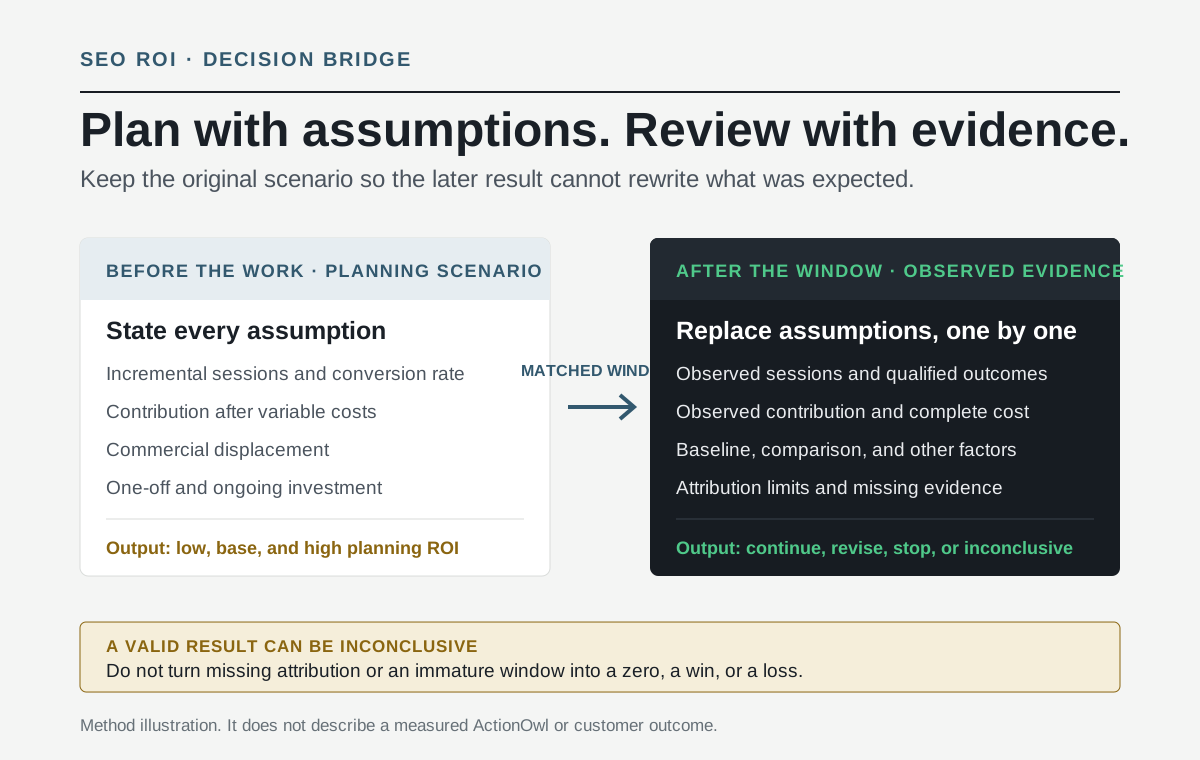
A forward scenario uses forecast sessions, expected conversion, contribution, and complete cost. Retrospective measurement uses comparable observed windows, the same contribution definition, actual cost, and named confounders—other changes that could affect the result. If the change was not measurable or the signal is unclear, record an inconclusive result instead of manufacturing ROI.
Interactive calculator
The example values are fictional. Use one currency throughout; this tool labels the values but does not convert them.
Input method
Use one defined query-and-page cohort. If the traffic estimate is still uncertain, first create a low, base, and high range with the SEO forecasting tool. That tool outputs clicks. Convert each case to sessions with a matching, observed click-to-session rate from the same market and window before running it here. If no matching rate exists, disclose the proxy and widen the range.
Use the expected session gain above the current baseline, not all organic traffic. Keep the market, device, query set, page set, and time window aligned. Search Console clicks and analytics sessions are different units; do not silently treat them as one-to-one.
Prefer a rate from comparable non-branded organic sessions and the same conversion definition. If the sample is weak, widen the scenario instead of borrowing the sitewide average without explanation.
Contribution per conversion is the amount left after relevant costs that vary with that conversion, including expected returns or fulfilment where applicable, but before the SEO investment entered separately. For lead generation, it may be expected contribution per qualified lead after lead-to-sale probability. Do not label revenue as contribution.
Estimate the share of modelled conversions that would likely have happened through another channel or journey without this SEO action. This is not the forecast's query/page traffic-overlap input. A 20% displacement assumption retains 80% of modelled conversions as incremental.
Include research, content, design, engineering, migration, review, tools, agency or employee time, and recurring maintenance when those costs are required by the action.
If you model six months of contribution, include six months of recurring investment. Review technical completion early, but judge business return only after a suitable outcome window.
Take the fictional example loaded in the calculator: 800 incremental sessions per month, a 2.5% conversion rate, 70 EUR contribution per conversion, and 20% commercial displacement. Across six months, 4,800 sessions produce 120 modelled conversions; after displacement, 96 remain incremental and create 6,720 EUR in modelled contribution.
The same window includes 1,500 EUR of ongoing monthly investment and 3,000 EUR of one-off work: 12,000 EUR in total. Net return after SEO investment is therefore −5,280 EUR and planning ROI is −44%. The action would need about 171.4 conversions to break even at the stated unit contribution.
That is not a failed calculator. It is a useful decision signal. The team can reduce scope, improve the evidence, choose a stronger opportunity, or record no action instead of forcing the project through.
Interpretation
The percentage alone cannot tell you whether to proceed. Read it beside the break-even requirement, the low/base/high range, cash timing, and the evidence quality behind each input.
The modelled contribution does not recover the investment. Reduce scope, improve the mechanism, or choose no action.
Small assumption changes can reverse the decision. Resolve the highest-impact uncertainty before committing more cost.
A positive scenario is permission to test, not proof. Confirm implementation, then compare observed contribution with the recorded baseline and window.
Questions
There is no universal percentage. The required return depends on cash constraints, risk, evidence quality, alternatives, and how long capital and team capacity are committed. Compare the scenario with the organisation’s own hurdle rate and competing actions.
Yes, as a planning range. Label every assumption, include the complete cost, and avoid presenting the result as observed ROI. After implementation, replace assumptions with measured values and preserve the original forecast for comparison.
Multiply the probability that a qualified lead becomes a customer by the expected contribution from that customer, then subtract any variable sales and service cost not already included. Keep the qualification definition consistent.
Organic search can displace branded, paid, direct, or other journeys. The input prevents every modelled conversion from being treated as completely new when the evidence cannot support that claim. It is separate from traffic overlap already removed in the forecast; never apply the same reduction twice.
ActionOwl evidence-to-action sprint
Bring one SEO decision and the evidence you have. The sprint combines ActionOwl with expert-assisted research and delivery: choose one bounded action, ship it or hand it to your team, and agree how to check the result.
ActionOwl is in private alpha and owns the sprint. Maivor AB contracts and invoices for it.
This is a paid, individually scoped sprint. ActionOwl has no connected write executor and does not guarantee rankings, traffic, or revenue.
Optional analytics. ActionOwl counts visits with Google Analytics, routed through this domain and loaded only if you allow it.
No tracking before you choose. Details in the privacy policy.