Day 14: technical
Confirm the page is reachable, indexable as intended, present in the sitemap, internally linked, and producing the required measurement events.
SEO roadmap template and guide
Plan one SEO opportunity from first evidence to outcome review. Give each decision an owner, a check to pass, and a reason to stop. Use the full template below or download the CSV.
The full template is free. No email required.
Each step needs evidence, not just a date
Evidence missing? Investigate or take no action.
Continue only when the evidence supports the next step.
An SEO roadmap is a decision record for moving from an observed opportunity to a measured result. It should connect the work to a business outcome, preserve the evidence that justified it, make ownership explicit, and define the gate for continuing.
A list such as “publish blogs, fix technical SEO, build links” does not do that. It names channels without showing which customer problem they address, which page or query cohort is in scope, what they could contribute, or what evidence would make the team change direction.
Visible, adaptable template
The rows are decision stages, not mandatory deliverables. Replace the prompts with evidence from one real opportunity and remove any row that does not change the decision.
| Stage | Decision | Required evidence | Owner | Acceptance gate | Verification | Stop condition |
|---|---|---|---|---|---|---|
| Outcome | Choose one business outcome and one guardrail for this roadmap. | Current metric definition, owner, baseline, and readable source. | Business owner + growth lead | The outcome can be read consistently before work starts. | Record the baseline window and source. | The outcome is undefined, unreadable, or outside the team’s influence. |
| Opportunity | Select one query-and-page cohort with a plausible customer mechanism. | Search intent, current first-party page evidence, live SERP review, and a sourced demand range when available. | Growth lead | One page or bounded page set can satisfy the observed intent. | Save the query set, market, device, provider, and evidence date. | Intent is mixed beyond a workable page or no observable evidence supports a bounded opportunity. |
| Value | Estimate low, base, and high contribution after forecast-cohort overlap, commercial displacement, and complete cost. | Traffic range, conversion definition, unit contribution, and investment. | Growth lead + finance or commercial owner | The base case clears the organisation’s decision threshold. | Retain formulas, sources, assumptions, and the no-action case. | The defensible upside cannot justify implementation and measurement effort. |
| Action | Commit one bounded change and name the person responsible for delivery. | Exact target, current state, proposed state, dependencies, and risks. | Named implementer | Scope, acceptance criteria, guardrails, and rollback path are explicit. | Capture the deployed change and implementation date. | Required access, capacity, or safe rollback is missing. |
| Technical check | Confirm the intended change is live and observable before judging results. | Rendered page, crawl/index state, analytics event, and release evidence. | Implementer + measurement owner | The change and its measurement path both pass. | Run a dated technical check after release. | The change is absent, broken, blocked, or not measurable. |
| Outcome review | Continue, revise, merge, or stop after the declared evidence window. | Comparable baseline and outcome windows, limitations, and confounders. | Business owner | The observed result meets the pre-declared success condition. | Record successful, unsuccessful, worse, or inconclusive, then retain the learning. | The signal remains immaterial or the same assumption fails again. |
The table scrolls horizontally on a narrow screen. The CSV contains the same seven columns and six starter stages.
Completed fictional example
This example is deliberately narrow. It shows enough context for another person to review the evidence, complete the work, and know when to stop. Confounders are other changes that could affect the result. This is a teaching fixture, not a report of ActionOwl customer results.
| Decision | Exact target | Evidence class | Owner | Acceptance criteria | Verification date and window | Other factors that could affect the result | Stop condition |
|---|---|---|---|---|---|---|---|
| Improve the search result explanation before creating another guide. | Fictional /returns-policy page and its non-brand delivery-and-returns query cohort. | Measured first-party GSC query/page rows plus a dated live-SERP observation; demand-tool volume remains an external estimate. | Mira, growth lead; Arun, web implementer; Jo, commercial reviewer. | One clearer title and description are live, canonical is unchanged, the page answers the observed intent, and the tracking annotation is recorded. | Technical check on 4 September; compare two complete 28-day windows on 3 October after excluding the QA session. | Seasonal promotion, a shipping-price change, low query volume, and any result-page feature change. | Stop or consolidate if the page is known and measurable but shows no relevant non-brand exposure or external use after the declared window. |
How to use it
Complete these in order. A failed gate is information: pause, revise, or stop instead of moving an unsupported item into production.
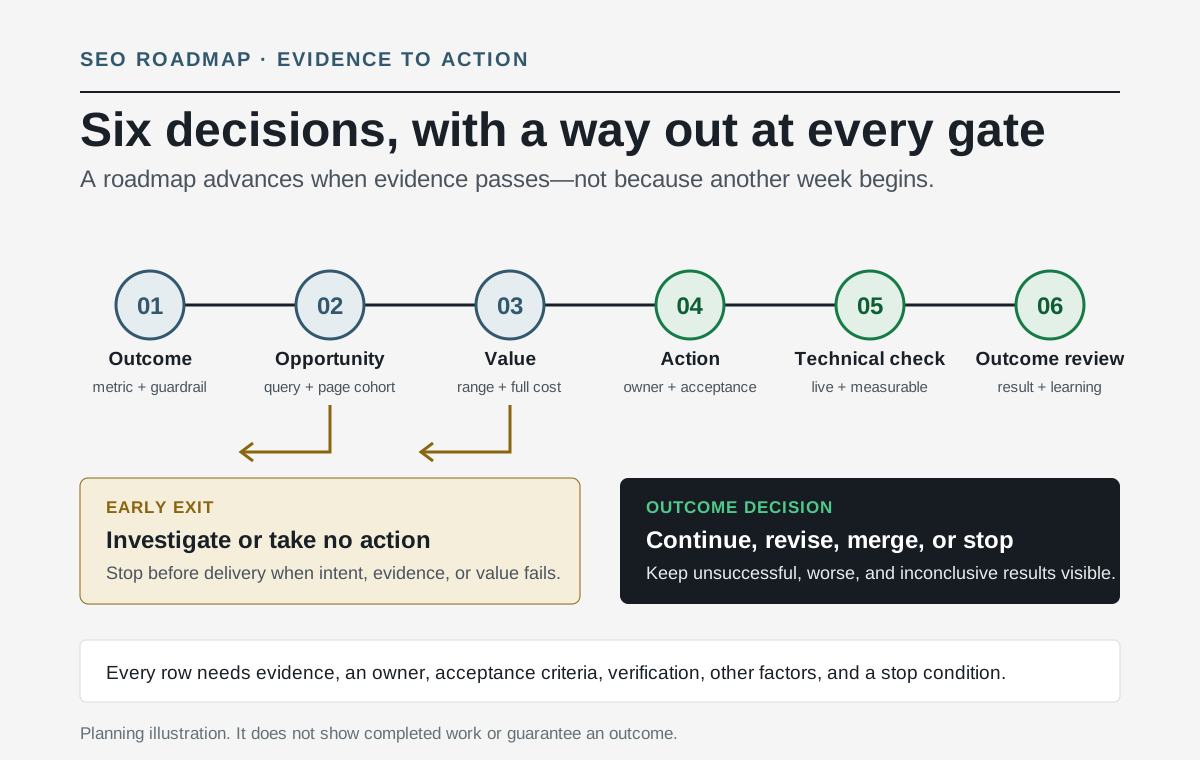
Each gate removes a different kind of ambiguity: why the work exists, what decision it supports, who owns it, what completion means, when evidence will be checked, and which result ends the work. A failed gate can lead to investigate, revise, no action, or stop.
Name the business change the roadmap should influence and the constraint it must not harm. For example, qualified enquiries may be the outcome while lead quality or support capacity is the guardrail. Confirm both are measurable before promising work.
Group queries that share an intent and can be served by the same realistic page or page set. Inspect the live results in the target market. If one page cannot satisfy the mixed intent, split the opportunity before forecasting it.
Build a low, base, and high SEO traffic forecast and carry the scenarios into the SEO ROI calculator. Record complete cost, forecast-cohort overlap, commercial displacement, evidence gaps, and the no-action case.
Name the exact page, template, redirect, tracking event, or technical surface that will change. Add an owner, acceptance criteria, dependencies, guardrails, and a rollback path. “Improve SEO” is not an implementable action.
First confirm that the intended change is actually live, crawlable where relevant, and measurable. Only then start the outcome window. This avoids judging a commercial hypothesis when the implementation never reached the user or search engine.
Compare equivalent windows and state limitations. Mark the result successful, unsuccessful, worse, or inconclusive, then choose continue, revise, merge, or stop. Preserve what the team learned instead of quietly replacing the original forecast. “No action” belongs at the earlier opportunity or value gate, before implementation begins.
A score can help sort a long list, but it can also disguise weak evidence. Before assigning a position, ask four questions in plain language:
If an item fails one of those questions, label the missing condition. Do not hide it behind a decimal priority score. Items with unresolved dependencies belong in investigation, not in a committed delivery lane.
Example review cadence
The right timing depends on the change and market. A practical content launch might use the following checkpoints, declared before publication rather than chosen after seeing the result.
Confirm the page is reachable, indexable as intended, present in the sitemap, internally linked, and producing the required measurement events.
Review impressions, emerging queries, page selection, and search intent. Revise a mismatch; do not judge final business return yet.
Require meaningful evidence across at least two declared signals before expanding. Otherwise revise, merge overlapping content, or stop.
Questions
Long enough to show the decisions, dependencies, owner, verification, and stop condition—no longer. One evidence-qualified action can be a complete roadmap. A larger site may need several cohorts, but each should remain independently measurable.
Capacity planning may be quarterly, but evidence does not arrive on a quarter boundary. Use dated review windows for each action and revisit the committed sequence when a gate fails or a stronger opportunity appears.
The roadmap contains evidence-qualified decisions the team can own and verify. The backlog can hold unqualified ideas and requests, clearly labelled as such. Moving an item between them should require an explicit gate.
Update it when evidence changes a decision, an implementation passes or fails, or an outcome window closes. A regular review helps, but do not rewrite the original forecast or acceptance criteria after the result is known.
ActionOwl evidence-to-action sprint
Bring one SEO decision and the evidence you have. The sprint combines ActionOwl with expert-assisted research and delivery: choose one bounded action, ship it or hand it to your team, and agree how to check the result.
ActionOwl is in private alpha and owns the sprint. Maivor AB contracts and invoices for it.
This is a paid, individually scoped sprint. ActionOwl has no connected write executor and does not guarantee rankings, traffic, or revenue.
Optional analytics. ActionOwl counts visits with Google Analytics, routed through this domain and loaded only if you allow it.
No tracking before you choose. Details in the privacy policy.