Opportunity
Demand, clickability, and target capture describe how many clicks could exist before adjusting for your current click baseline.
SEO forecasting guide and tool
Estimate the extra organic clicks an SEO opportunity could bring. Build a low, base, and high SEO forecast, then see which assumptions change the decision.
Free to use. No account or email required.
From potential clicks to a restrained forecast
400 × 35% × 90% × 85% = 107.1
A scenario, not a growth promise or your calculator result.
SEO forecasting estimates a possible outcome from stated inputs. Choose one group of queries and pages—a query-and-page cohort—and ask: could the extra traffic justify the work and the time needed to measure it?
That is different from predicting exactly how much traffic a site will receive. Rankings move, search results absorb clicks, demand changes, and pages compete with traffic the site already earns. Hiding those uncertainties inside one point estimate makes the number look precise without making the decision safer.
Transparent method
Separate the addressable click opportunity from the chance of achieving it. That keeps a large keyword market from being mistaken for an attainable result.
Gross clicks = monthly searches × organic search-result clickability × target organic capture rate
Incremental clicks = max(0, gross clicks − current clicks) × ranking probability × seasonality × (1 − forecast-cohort overlap)
Demand, clickability, and target capture describe how many clicks could exist before adjusting for your current click baseline.
Current clicks remove the existing baseline. Forecast-cohort overlap removes incremental clicks shared with another separately planned cohort.
Ranking probability and seasonality make risk visible instead of burying it in optimistic CTR assumptions.
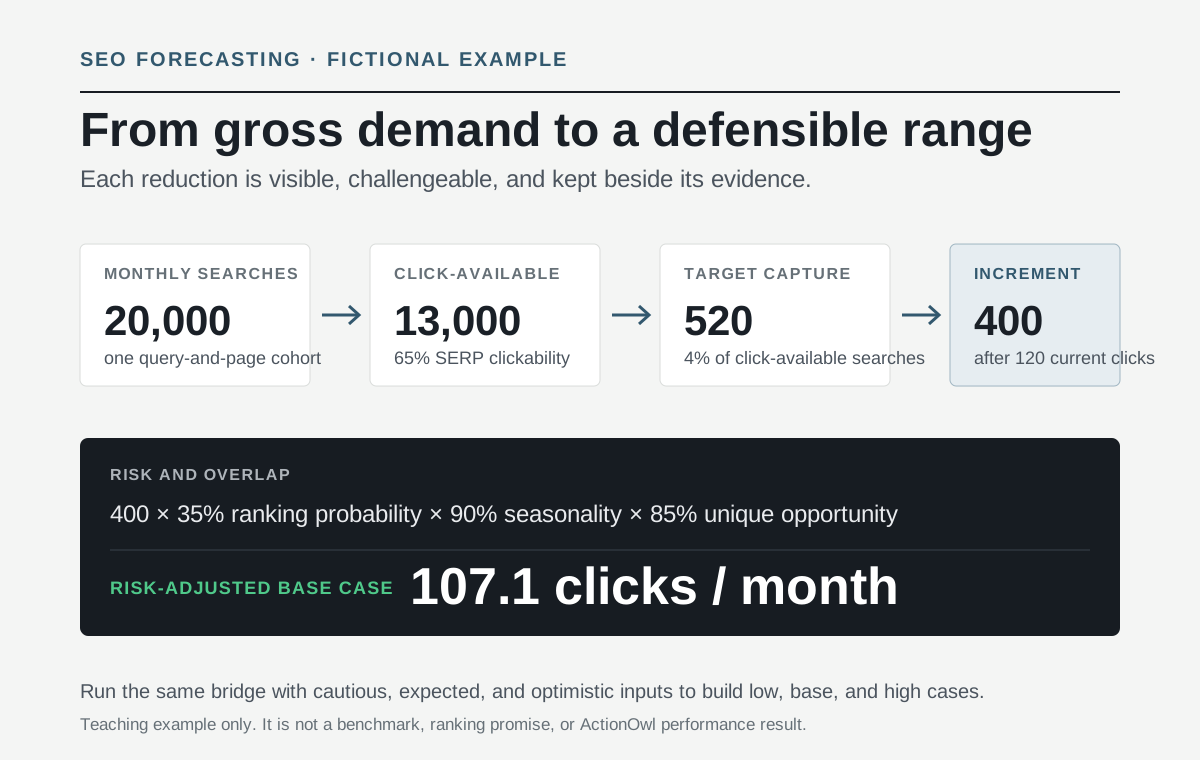
Search demand is only the starting pool. SERP clickability, realistic capture, the current baseline, ranking probability, seasonality, and overlap each answer a different question. Keeping them separate shows which assumption controls the decision.
Interactive worksheet
The example values are fictional starting points, not benchmarks. Replace them with dated evidence and assumptions that someone else can challenge. Target capture is conditional on click-available searches; if your capture-rate source already includes no-click searches, set clickability to 100% to avoid reducing the same searches twice.
Input guide
Record the source and date for every input. When a source is missing, use a wider range or mark the forecast unavailable instead of treating absence as zero.
Add only queries that one realistic page or page set can satisfy. Keep country, language, and device assumptions consistent, and retain provider disagreement rather than averaging it away.
Estimate the share of searches where an organic click remains available after ads, answer panels, maps, shopping results, and no-click outcomes. Inspect the live results page; keyword volume alone cannot answer this.
Estimate the share of click-available searches your result could earn. A branded result, product grid, local pack, and editorial guide should not share one universal rate. Combine this rate with clickability only when the rate is conditional on click-eligible SERPs. If a CTR benchmark already uses all impressions or searches—including no-click outcomes—set clickability to 100% to avoid a double reduction.
Read the same query-and-page cohort in Search Console using the same market, device mix, and time basis as the demand input. Subtracting this current click baseline turns a gross opportunity into an incremental one.
Express the chance that the proposed page and implementation can reach the assumed CTR band. Evidence may include current position, result quality, domain strength, links, technical constraints, and competing pages.
Use 100% for a neutral month, below 100% for a softer period, and above 100% for a stronger one. Compare matching historical windows when data is available.
Use 0% for one deduplicated query-and-page cohort. Reduce the result only when separate planned forecast cohorts share the same incremental click opportunity. This is not the ROI calculator's later commercial-displacement adjustment.
Imagine a fictional topic with 20,000 relevant monthly searches. If 65% of those searches can produce an organic click and the target result could capture 4% of click-available searches, the gross opportunity is 520 clicks. The site already receives 120, leaving 400 potentially incremental clicks.
Apply a 35% ranking probability, a 90% seasonal adjustment, and 15% overlap with another planned forecast cohort. The planning result becomes about 107 incremental clicks per month—not 520. The smaller number is more useful because every reduction is visible and contestable.
The next question is economic, not editorial: could those clicks create enough contribution to justify the work? Convert clicks to sessions with a matching observed click-to-session rate, then use the SEO ROI calculator with the low, base, and high session ranges rather than carrying only the optimistic case forward. Never silently treat clicks and sessions as interchangeable.
Overlap worked example
Two query cohorts can look separate in a spreadsheet while competing for the same searcher, result, or landing page. Estimate that shared opportunity before adding the forecasts together.
| Line | Monthly incremental clicks | Why it belongs in the calculation |
|---|---|---|
| Fictional cohort A | 140 | A page group forecast for one observed search job. |
| Fictional cohort B | 90 | A second page group whose queries partly reach the same opportunity. |
| Incorrect total | 230 | 140 + 90 silently counts the shared opportunity twice. |
| Base overlap adjustment | −50 | The estimated click opportunity already represented in both cohorts. |
| Adjusted base case | 180 | 230 − 50 gives one deduplicated planning case. |
If the shared opportunity is only known to be between 40 and 65 clicks, report a combined range of 165–190, not a precise 180. The example is fictional; uncertainty remains because query intent and landing-page competition can change as the result page changes.
Ungated forecast template
Download a blank CSV with low, base, and high rows plus evidence source, evidence date, owner, and notes. It contains no tracking fields and asks for no email.
In Excel, open the file with Data → From Text/CSV. In Google Sheets, use File → Import → Upload. Keep percentages as values from 0 to 100, use one copy per query-and-page cohort, and replace every blank with a sourced input or an explicit unavailable state. The file is an evidence register; use the calculator above to produce the low, base, and high results.
Decision rules
A forecast earns trust by showing what would change the decision. Review the range before implementation and again when real evidence arrives.
The base case clears the business threshold, the low case is survivable, and the required page and measurement access exist.
One assumption controls most of the outcome. Gather that evidence before committing the larger implementation.
Even the defensible upside cannot justify the cost, the evidence is too weak, or another constraint blocks measurement.
Questions
Accuracy depends on the quality and scope of the inputs. Treat the output as a decision range, record actuals, and recalibrate. A narrow forecast with dated evidence is usually more useful than a precise-looking sitewide number.
Rankings are an input to a business decision, not the outcome. Model traffic after SERP clickability and CTR, then connect the resulting range to conversion contribution and cost.
Keep both values with their provider, location, language, and date. Use the lower defensible value in the low case and explain the disagreement; do not average it into false agreement.
When the opportunity cannot clear the decision threshold, required evidence is unavailable, the page cannot satisfy the intent, or implementation and measurement constraints make the result untestable.
ActionOwl evidence-to-action sprint
Bring one SEO decision and the evidence you have. The sprint combines ActionOwl with expert-assisted research and delivery: choose one bounded action, ship it or hand it to your team, and agree how to check the result.
ActionOwl is in private alpha and owns the sprint. Maivor AB contracts and invoices for it.
This is a paid, individually scoped sprint. ActionOwl has no connected write executor and does not guarantee rankings, traffic, or revenue.
Optional analytics. ActionOwl counts visits with Google Analytics, routed through this domain and loaded only if you allow it.
No tracking before you choose. Details in the privacy policy.